
From TMOS PhD to founder: Gabriel Ivan is building Chyral at the frontier of photonics and health sensing
15 Jul, 2026
For many researchers, a PhD is the culmination of years spent advancing a specialised question. For Gabriel Ivan, it is also the foundation of a company. As a TMOS PhD researcher and founder of Chyral, Gabriel is working at the intersection of photonics, AI, and health technology to pursue an ambitious goal: making it possible to measure important biomarkers through the skin, non-invasively and in real time.
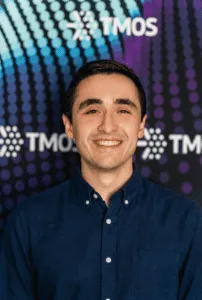
The idea began forming long before Chyral and the PhD. In the final year of his undergraduate engineering degree, Gabriel built a wearable, light-based health sensor for his capstone project. The device could measure heart rate and even stress levels through the skin. That project opened a much bigger line of inquiry: what else could light reveal? Could it one day help measure blood sugar, hormones, or early indicators of disease without the need for fingerpricks, patches, or blood draws?
“I became obsessed with this question,” Gabriel says. Part of the fascination was personal – he liked the idea that such capabilities might one day sit on a smartwatch – but the deeper pull was scientific. The problem was hard, important, and strangely unresolved. Decades of research have shown that light can detect useful biological signals, yet only a handful of biomarkers, such as heart rate and blood oxygenation, have been measured non-invasively in ways that became practical at scale. Much of the body’s chemistry remains effectively hidden unless the skin is broken.
As Gabriel studied the history of the field, one theme kept reappearing: promising proof-of-concept studies rarely made the leap into products. The central barrier, he argues, is calibration stability. Blood and skin vary substantially from person to person, and even within the same person over time. Any sensor attempting to read chemistry through the skin must separate a very small signal from a highly variable biological background. That is not just a technical detail: it is the difference between a compelling laboratory demonstration and a technology that can be trusted in clinics, on wearables, or in everyday health settings.
That translational gap became the rationale for Chyral. The company is building AI-powered optical sensors to measure biomarkers such as glucose and lactate through the skin. Its approach combines hardware and software from the outset, pairing optical sensing with a proprietary AI model designed to generate reliable measurements across people, environments, and devices without requiring per-person calibration. In simple terms, Chyral is working to move non-invasive sensing from promising possibility toward practical reliability.
The timing is unusually favourable. Photonics hardware is becoming more capable and more affordable. AI performance continues to improve while the cost of compute falls. At the same time, the broader rise of AI for biology is changing expectations about what data-rich medicine might become. In this context, Gabriel frames Chyral’s mission in strikingly simple terms: building the eyes for AI to understand human bodies.
The commercial and clinical implications are wide-ranging. If robust non-invasive measurement can be achieved, the impact could extend across chronic disease management, critical care medicine, consumer health, drug development, and future personalised diagnostics. Those possibilities have been reinforced not only by theory, but by conversation. An anaesthetist told Gabriel that real-time lactate would sit high on an ICU wish list. Researchers described continuous blood monitoring as a capability that could open entirely new lines of investigation. A drug development company saw optical sensing as something that could help unblock clinical trials. People living with diabetes pointed directly to the burden of invasive monitoring in daily life.
The future of medicine needs light to see inside the body in real time. Chyral is building the eyes for AI to understand human bodies.
Like many deep-tech ventures, Chyral’s progress has been marked by both technical persistence and unusual founder moments. Gabriel describes the journey as exhilarating, difficult, and epic: practising investor pitches by speaking to strangers on a train, sitting with a cardiac surgeon during cardiopulmonary bypass to understand blood monitoring needs, and storing litres of blood samples in his home fridge after running out of lab space. He has also had to absorb scepticism from people he respects while finding mentors among some of his scientific heroes. The pattern is familiar in research translation: conviction matters, but so does the willingness to learn from every conversation.
One milestone stands out. After years of research and simulation work, Gabriel achieved his first experimental result measuring lactate using light in blood-like samples. It was, he says, the moment the idea made contact with reality. That result did not solve the whole problem, but it provided a concrete sign that the solution was within reach.
The next step is even more consequential: a first-in-human feasibility study designed to test whether Chyral’s sensor can measure biomarkers through skin without per-person calibration. Success at that stage would do more than validate a scientific hypothesis. It would provide strong evidence that the company’s core approach can bridge the gap between laboratory promise and real-world utility, opening the door to deeper clinical partnerships, product development, and a path to market.
That next phase is closely tied to Gabriel’s research journey. Over the coming months, he is set to spend time in Sydney undertaking optical characterisation work at the TMOS UTS node, using specialised facilities to generate the data needed for the company’s R&D and for his doctoral work. He does not treat the PhD and the company as competing agendas. “It feels like the same problem attacked from two different angles,” he says. His PhD focuses on the fundamental limits of light-based detection; Chyral exists to push those limits toward practical application.
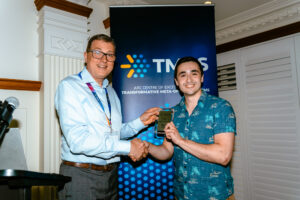
TMOS has been a significant part of that journey. Gabriel points to tangible support such as funding, lab equipment, and recognition through the TMOS Industry Award, but just as important is the surrounding culture. Being part of a community of researchers tackling difficult problems in photonics and related fields has helped reinforce the idea that technical excellence and translational ambition do not need to be separate paths. In that sense, his story is not only about a founder and a startup. It is also about what a research centre can make possible when it supports entrepreneurship alongside scholarship.
Chyral is now entering a phase where the company is looking not only for capital, but also for the people and partnerships that can help shape its next milestone. Gabriel is particularly interested in engaging experimental scientists, hardware engineers, collaborators, and investors who understand the long horizon and high leverage of deep-tech health innovation. For TMOS, that makes his story more than a profile piece. It is an example of research translation in motion: a reminder that the future of Australian photonics will be shaped not only by what is discovered in the lab, but by what is built from it.
For Gabriel, the broader ambition remains clear. If medicine is to become truly data-driven and personalised, it will need better ways of seeing into the body in real time. Chyral, he believes, can help build that capability. It is an optimistic vision, but a grounded one – anchored in technical difficulty, real use cases, and the patient work of turning frontier research into something the world can actually use.