
Researchers use light to reprogram a tiny optical device
28 Sep, 2026
A tiny device that can be reprogrammed using a laser could lead to adaptable devices for computing, imaging and telecommunications.
Most devices are built to perform a particular job. If you want them to do something different, you generally need to replace a component, rewire the system or manufacture a new one.
For example, every time you ask a large language model such as ChatGPT or Claude a question, many electrical signals race through computer chips, carrying information and performing calculations.
This takes energy, and lots of it.
Scientists are always searching for faster and potentially more energy-efficient ways to process information. One possible solution is to replace some electrical signals with light.
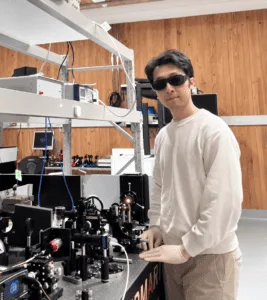 An international team of researchers led by the ARC Centre for Transformative Meta-Optical Systems (TMOS) at The Australian National University – in collaboration with researchers from at Nottingham Trent University in the UK and Friedrich Schiller University Jena in Germany – combined an ultrathin optical surface with liquid crystals, the material used in many electronic displays.
When a laser was shone on the device, it rotated the liquid crystal molecules and changed the way the surface interacted with light.
Lead researcher Ziwei Yang says the response or function of a static metasurface cannot be changed after fabrication.
“But by shining light on the liquid crystal, we have another way to tune that function without fabricating the device again.”
A road system
The device is a metasurface, which is a thin material covered with structures smaller than the width of a human hair.
These tiny structures are designed to control the properties of light – such as colour, strength and direction. It can be imagined as a miniature road system for light, determining where it can travel and what happens to it along the way.
However, for most metasurfaces, these ‘roads’ are permanently fixed once the device is manufactured.
“With a static metasurface, you cannot change its response or its function after you fabricate it,” Yang says.
To make their metasurface adjustable, the researchers surrounded its tiny silicon structures with liquid crystals. Liquid crystals are made from molecules that can change direction in response to an outside force.
In electronic displays, that movement is normally controlled using electricity and electrodes. The researchers instead wanted to find out whether light itself could rotate the molecules and alter the device.
“Our question was whether light could directly tune or program the function of the metasurface, without needing contact electrodes,” Yang says.
When the researchers shone a laser on the device, this produced a tiny twisting force, known as optical torque, which rotated the liquid crystal molecules.
This changed the optical conditions around the silicon structures and altered how the metasurface responded – the laser temporarily rearranged the road system.
Experiments using light to control liquid crystals have been documented since the late 1990s, Yang says, but the change was small and difficult to observe. Adding the metasurface made the effect much clearer.
“The metasurface works as a platform, or even as an amplifier,” Yang says.
“It makes these changes much easier to observe. We combined the metasurface and the liquid crystal, and that is where it became interesting.”
Changing light
The team first showed that the laser could change the metasurface’s resonance – the wavelength of light with which it interacts most strongly.
Resonance is what happens when a material interacts strongly with a specific wavelength of light. It can be compared to pushing someone on a swing – when each push matches the swing’s natural rhythm, the effect becomes stronger. In a metasurface, changing the resonance changes which wavelengths of light receive that stronger response.
While this was an important first step, Yang says the most interesting result emerged when the team moved into the world of nonlinear optics – when very intense light interacts with a material and produces effects that do not occur under ordinary lighting conditions.
The team used the device to convert invisible infrared light into visible green-yellow light through a process called third-harmonic generation.
As the laser rotated the liquid crystals, it shifted the metasurface’s resonance. Depending on the wavelength used, this could increase or reduce the amount of visible light produced.
The laser was therefore doing two things at once – producing the new light and changing the way the device produced it.
Yang says this achievement is important because the device does more than turn a light signal on or off. It suggests that light could be used to alter the function of an optical component while it is operating.
He says the key advance is that this function is no longer permanently built into the material.
“All tunable metasurfaces are trying to move beyond static devices,” he says.
“With light shining on the liquid crystal, you have the chance to tune the function after fabrication.”
More than a switch
One possible application for the technology is in optical computing, where light could carry the information and perform some of the calculations which are currently handled by electrical signals.
While future optical computers would still need electricity to run lasers and other equipment, allowing light to perform more of the processing could eventually make some tasks faster or more energy efficient.
Yang says the team’s device may be particularly useful for optical neural networks – the computing systems behind many forms of AI.
A neural network contains layers that process information. Its nonlinear layers allow it to recognise complicated patterns, make distinctions and learn from data. Without those layers, even a large neural network would have difficulty solving complex problems.
“At the moment, the nonlinear layer is mostly controlled by electronics,” Yang says.
“If we can somehow use light to directly control this nonlinear layer directly, it could be useful for optical neural networks in the future.”
The same principle could eventually be used in imaging, telecommunications and systems that steer beams of light without moving mechanical parts.
The technology remains at an early stage, with the researchers now wanting to reduce the amount of laser power needed to reconfigure the device.
The next stage will require “more experiments and rigorous theory” says Yang, to refine the device and test whether it could work in a practical system.
All-optical control of nonlinear emission from resonant metasurfaces
Ziwei Yang, Lei Xu, Gabriel Sanderson, Akhshay Bhadwal, Luyao Wang, Katsuya Tanaka, Muyi Yang, Mingkai Liu, Shaun Lung, Isabelle Staude, Thomas Pertsch, Carl Brown, Mohsen Rahmani, Dragomir Neshev
Journal, 2026, https://doi.org/10.1126/sciadv.aeh0904
Abstract:
Nonlinear optics underpins a broad range of photonic technologies, from classical and quantum light sources to emerging nonlinear photonic neural networks. Yet, conventional nonlinear-optical devices exhibit static functionality: their transfer characteristics and emission profiles are dictated by the intrinsic nonlinear process and locked by fabrication, limiting adaptability. Here, we introduce an ultra-thin metasurface platform that enables dynamic reconfiguration of nonlinear functionality in a contact-less fashion. By leveraging all-optical control of the optical torque exerted on liquid crystal molecules infiltrating a resonant metasurface, we achieve tunable polynomial nonlinear transfer functions based on the third-harmonic generation process. This mechanism further allows reconfigurable modulation of nonlinear weighting across different diffraction orders, revealing a previously unexplored interplay between mode structure and nonlinear emission. Our approach opens up a pathway toward field-programmable nonlinear photonic systems, offering unprecedented flexibility for reconfigurable nonlinear signal processing and adaptive photonic computing.